
Lafayette County Probate Venue
The local probate venue is the Probate Division of the Lafayette County Circuit Court. The county court overview lists Circuit, Associate, and Probate as the Lafayette County judiciary divisions, and the probate page sits under the Circuit Clerk section. That matters for access. Probate filing questions, estate copy requests, certified copies, and public probate case inquiries route through Kim Mason's Circuit Clerk office rather than the Recorder of Deeds.
The public counter is at Lafayette Hall, one block south of the historic courthouse. Some court activity also uses the courthouse courtroom, so visitors should confirm the correct building before a hearing or copy pickup. The probate page does not publish a separate probate judge contact, separate probate counter, or separate probate database. For Lafayette County probate records, the practical chain is Case.net first for public indexed cases, then the Circuit Clerk for copies, older material, and documents not available remotely.
Probate Division of the Circuit Court
Clerk: Kim Mason, Circuit Clerk
Lafayette Hall, 116 S. 10th St.
PO Box 10, Lexington, MO 64067
660-259-6101
Lafayette.email@courts.mo.gov
8:00 AM to 4:30 PM, Monday through Friday
Lafayette County's probate page identifies the local probate filing context. The court image below comes from that source.
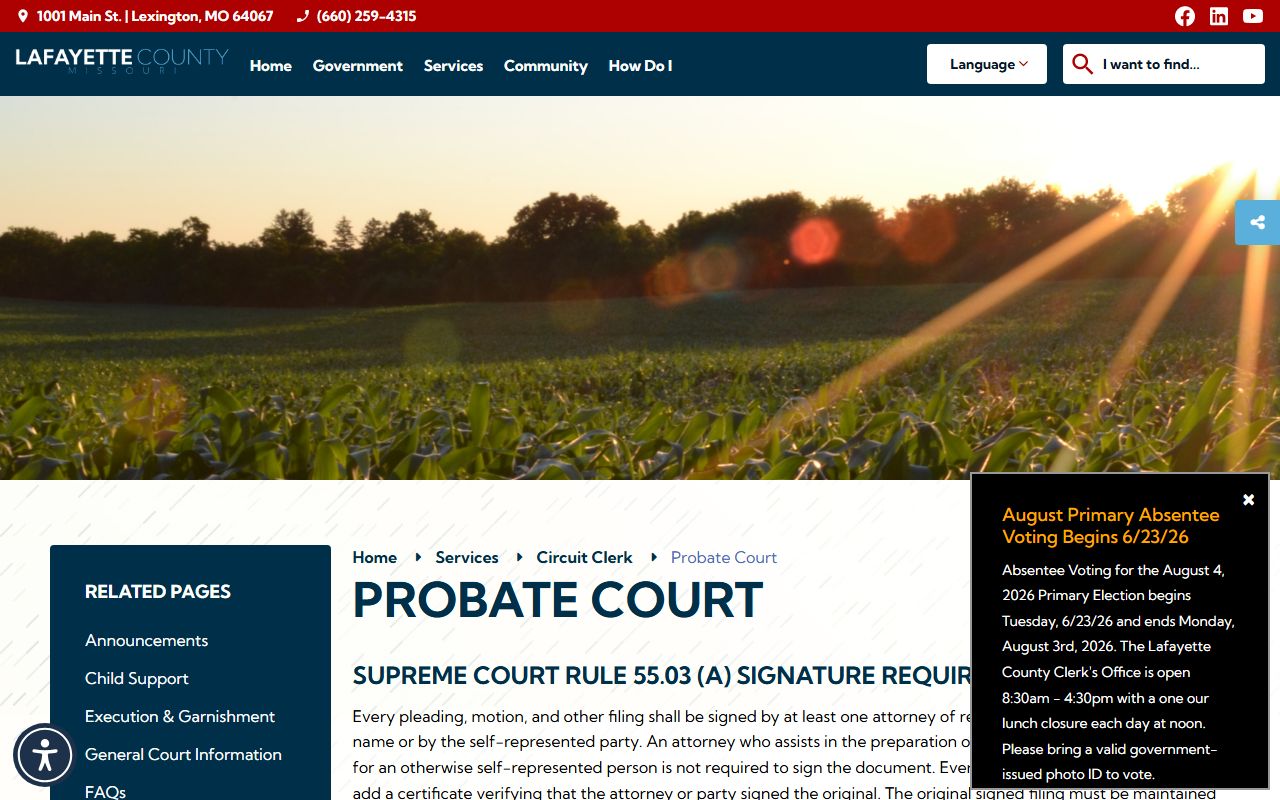
The page is useful because it confirms probate is administered through the Circuit Clerk's court services, not through a separate county-recording office.
Search Lafayette County Probate Records
Public probate case entries may be searched in Missouri Case.net when the case is indexed and open to the public. Lafayette County says its court office uses the Judicial Information System for case processing and electronic transfer of public information to Case.net. A probate search should narrow the court or county to Lafayette County or the 15th Judicial Circuit when that option is available, then use a party name, case number, filing date, or scheduled-hearing search.
Case.net is not the only access channel. Older probate books, loose wills, historical references, and non-digitized probate files may not appear in the same way as a current estate case. The Missouri Secretary of State County and Municipal Records Database can be checked for historical Lafayette County probate record references. That archive is not a live court docket, and the research notes that loose wills or probate case files may require a judicial database or clerk follow-up.
A good probate search separates the index from the document. The index may confirm that an estate, guardianship, or conservatorship case exists, but it may not supply the will, inventory, accounting, or order image needed for proof. When a family member, buyer, title researcher, or attorney needs a document rather than a docket entry, the request should move to the Circuit Clerk with enough detail to identify the file and the copy type.
- Search Case.net by name or case number and select Lafayette County or the 15th Judicial Circuit when possible.
- If the probate case is not visible, contact the Circuit Clerk with party names, case type, and an approximate year.
- For historical probate books or references, search the Secretary of State database by county and record type.
- Ask the clerk before assuming an online entry includes inventories, accountings, medical material, or certified copies.
Note: Case.net can show public probate docket data, but restricted documents and certified copies still require clerk review.
Lafayette County Probate Record Contents
Lafayette County probate records can include estate applications or petitions, wills, letters, notices, inventories, accountings, orders, guardianship documents, conservatorship documents, minor or incapacitated adult materials, and final settlements. A public index entry is often much thinner than the full court file. It may show the case number, filing date, division, case type, parties, attorney entries, docket events, orders, hearing dates, and status while leaving the actual document images unavailable online.
Probate overlaps with family and civil court practice but has its own vocabulary. A will file may turn on whether a person died with a valid will. A guardianship may concern care and decisions for a minor or an adult who cannot act alone. A conservatorship is usually about property and money. These terms affect which filings may be public and which may be limited because they contain medical, mental-health, minor, or protected personal data.
- Testator
- The person who made a will.
- Executor
- The person named to carry out the will and handle estate tasks after appointment.
- Intestate
- A death without a valid will, which can change who may inherit and who may administer the estate.
- Guardianship
- A court case about care, custody, or decisions for a minor or incapacitated adult.
- Conservatorship
- A court case about management of property or financial affairs for a protected person.
Missouri State Parks' Lafayette County Courthouse nomination material gives local courthouse context for records that may span historic books and modern electronic systems.
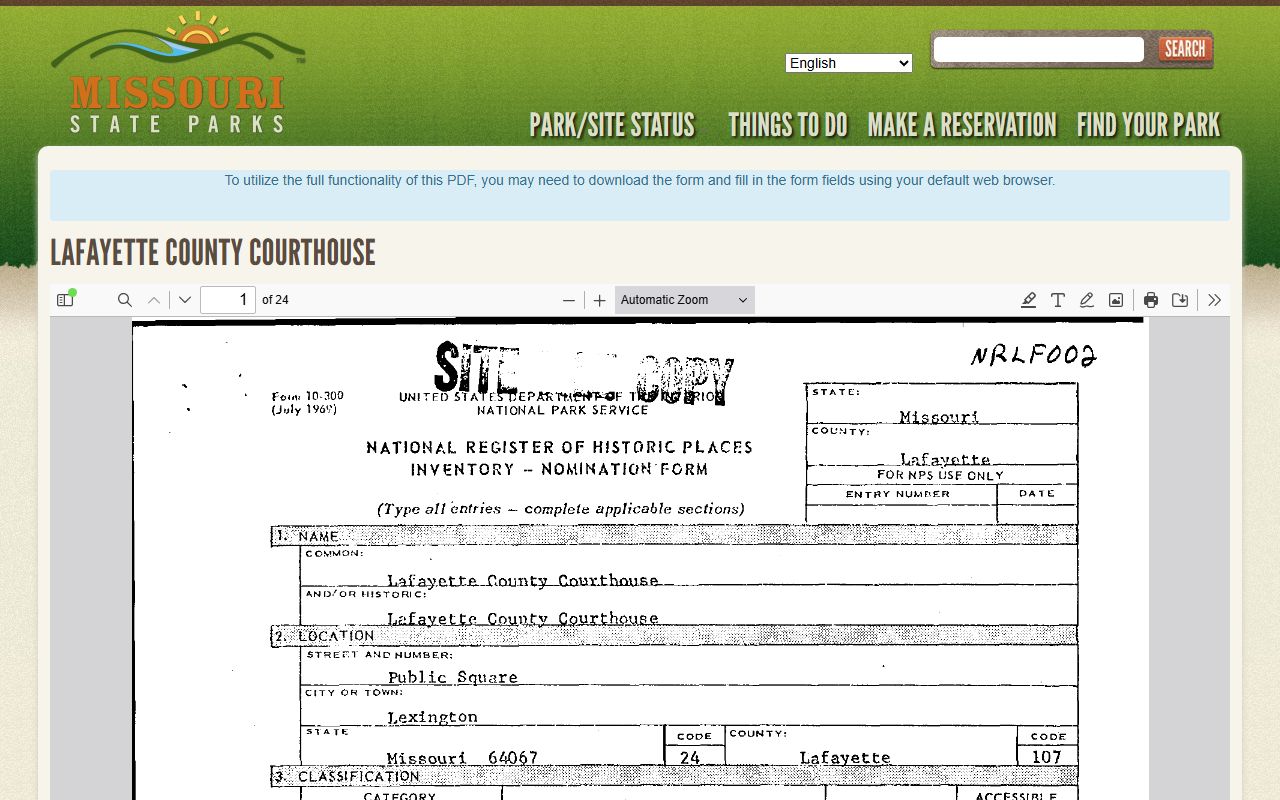
The courthouse history is relevant to probate research because old estate files may point back to book systems and archival indexes rather than a current online docket alone.
Lafayette County Probate Filing Rules
The Lafayette County probate page quotes Missouri Supreme Court Rule 55.03(a) on signatures. Every pleading, motion, and other filing must be signed by at least one attorney of record in the attorney's own name or by the self-represented party. The filing must print the signer's name, Missouri bar number if one applies, address, telephone number, fax number, and email address if any. For electronic filing, the filing must include a certificate verifying that the attorney or party signed the original.
An attorney who only helps a self-represented person prepare a filing is not required to sign it under the quoted rule text. An unsigned filing, or an e-filing without the required certification, can be stricken unless the omission is corrected promptly after notice. The Circuit Clerk forms page also states that only pro se forms approved by the Supreme Court or listed locally are acceptable in Lafayette County. Probate is one of the Supreme Court-approved form categories named in the local document center.
| Filing Item | What Lafayette County Research Supports |
|---|---|
| Signature | Attorney of record or self-represented party must sign pleadings, motions, and other filings. |
| Printed details | Name, bar number if applicable, address, phone, fax, and email should appear below the signature. |
| E-filing certificate | Electronic filings must certify that the original was signed. |
| Accepted forms | Supreme Court-approved or locally listed pro se forms are the acceptable form sources. |
Lafayette County Probate Fees
The research file confirms a local probate filing-fee heading but does not provide probate-specific dollar amounts. The safe approach is to verify current filing costs, certification costs, and copy costs with the Circuit Clerk before filing or ordering. Lafayette County's payment page says most fines, fees, and court costs assessed against parties are paid through the Circuit Clerk and expected upon disposition. It also lists payment methods for court financial transactions.
| Fee or Payment Topic | Confirmed Local Detail |
|---|---|
| Probate filing fee | Probate page has a filing-fee heading, but the researched source did not capture amounts. |
| Copy or certification cost | Verify with the Circuit Clerk because probate copy amounts were not captured. |
| Payment methods | Cash, money order, cashier's check, debit card, credit card, and Lafayette County resident personal checks. |
| Card processing | Credit-card payments carry a processing fee. |
For local form context, the Circuit Clerk's landlord complaint page shows how Lafayette County places specialized court forms under the same Circuit Clerk service area.
That related Circuit Clerk source reinforces the local pattern: specialized case types use court-service pages, forms, and clerk review rather than a single public download for every filing need.
Restricted Lafayette County Probate Records
Not every probate record is public in full. The research identifies restricted categories that can affect probate files: juvenile files, adoption records, mental-health proceedings, sealed cases, social security numbers, financial-account numbers, confidential redaction information sheets, minor names, protected addresses, medical information, and materials involving protected adults. A Case.net entry or file existence does not mean each image, exhibit, accounting, or medical document can be released remotely.
When a probate file concerns a minor, an incapacitated adult, or protected health details, the Circuit Clerk may need to review access before releasing copies. Historical probate references can also be incomplete without clerk or archive follow-up. The best request gives the case number if known, party or estate name, approximate year, record type, copy type, and a phone or email contact for fee and access questions.
Probate researchers should also keep the Recorder of Deeds boundary in mind. Marriage licenses and land records may help explain family history or estate property, but they are not substitutes for the probate case file. A deed, recorded marriage entry, or land index may point to useful facts, while the Probate Division record shows the court action, appointment, order, accounting, or final settlement.