
Lafayette County Arrest Records and Charges
Lafayette County arrest records begin with the law-enforcement side of an event. The arresting agency may be the Sheriff's Office, a local police agency, Missouri State Highway Patrol, the Conservation Department, or a federal agency making an arrest in the county. The sheriff detention page confirms the jail houses arrestees from those agencies and prepares inmates for court appearances. The court charge record begins later, when the prosecutor files or pursues formal charges in the court system.
The arrest record and the charge record serve different purposes. The arrest or booking record can relate to custody, jail intake, transport, and detention. The court charge record shows what the Prosecuting Attorney filed, how each charge is coded, whether the charge is pending, amended, reduced, dismissed, or resolved, and how the court case moves forward. Booking and custody details belong with inmate records. The full case file, plea, disposition, and sentence belong with Lafayette County criminal court records.
The Lafayette County Sheriff's Office is assigned here because arrest records start with law enforcement before charges move into court.

The sheriff source supports the arrest side of the arrest-to-charges pathway.
Find Lafayette County Arrest Records
There is no verified official Lafayette County Missouri app-only arrest search or live mugshot database in the research. For custody or arrest-record questions, call the Lafayette County Sheriff's Office at 660-259-3622 or request records from the sheriff or arresting agency. For the filed court charges after arrest, search Missouri Case.net by defendant name, case number, filing date, scheduled hearing, or judgment index. For copies or older records, contact the Circuit Clerk at Lafayette.email@courts.mo.gov or 660-259-6101.
- For custody or jail status, contact the sheriff rather than relying on third-party roster sites.
- For filed court charges, search Case.net by defendant name or case number.
- Open the case and read the charge list, count status, bond entries, hearing dates, and disposition.
- Call the Circuit Clerk for certified court copies or records not visible online.
- Request law-enforcement arrest or incident reports from the sheriff or arresting agency under Missouri Chapter 610.
The detention page is assigned because jail booking, transport, and custody are part of arrest-record context.
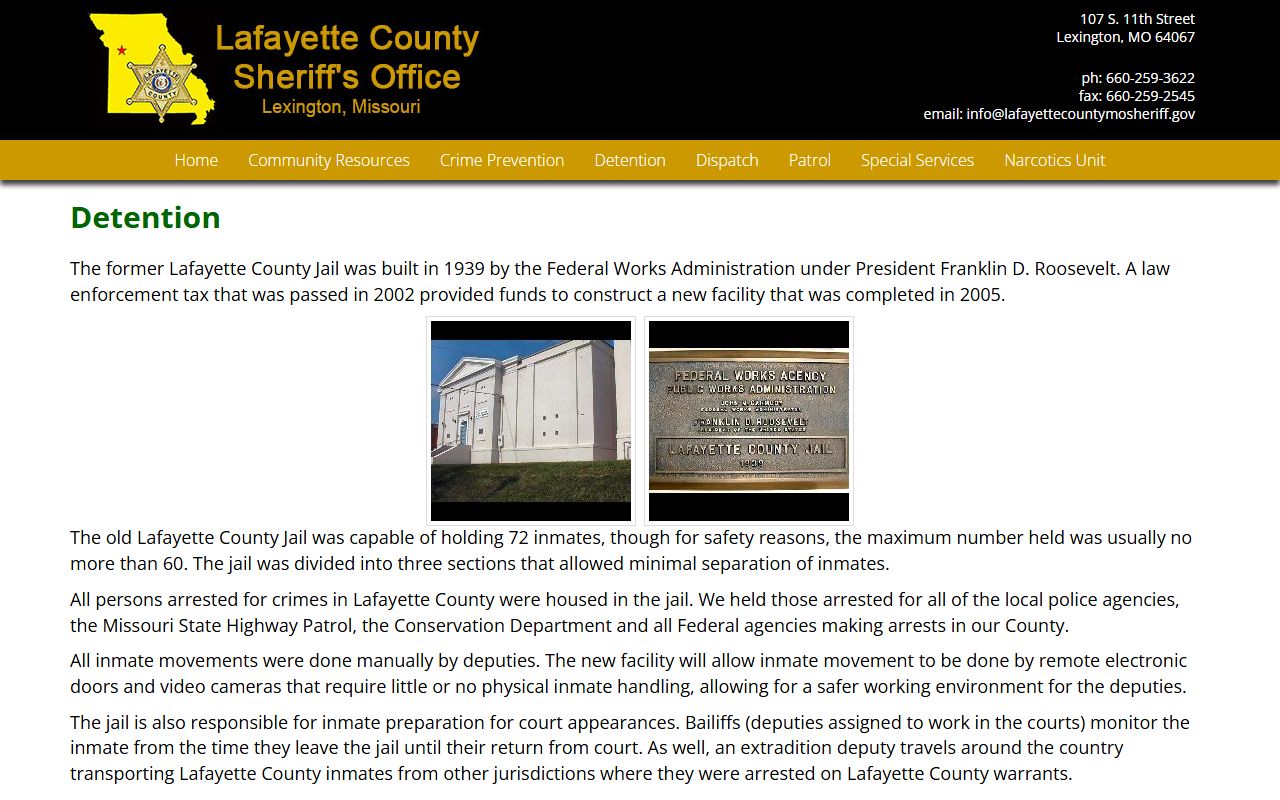
The detention source confirms the jail's role without creating a promise of a live official booking database.
Lafayette County Charges After Arrest
Missouri county prosecutors are Prosecuting Attorneys. Lafayette County Prosecuting Attorney Kristen Ellis Hilbrenner's office says it safeguards justice by enforcing Missouri criminal laws and child-support laws. The office handles cases ranging from traffic offenses to homicide after investigation by area law-enforcement agencies. Once a prosecutor files charges, the charge record belongs to the court case and is tracked through the Circuit Clerk, JIS, and public Case.net entries when available.
| Document | Filed By | What It Does |
|---|---|---|
| Complaint | Officer or prosecutor | Begins many criminal or ordinance matters and states the alleged violation. |
| Information | Prosecutor | Formal charge document used for many Missouri criminal prosecutions. |
| Indictment | Grand jury | Formal accusation returned by a grand jury in serious matters. |
Charge records may show the charge code, statute, count number, severity level, issuing agency, prosecutor, bond, first court date, and later changes. One arrest can produce no charges, one charge, or several separate counts. A case can also have charges reduced, added, amended, dismissed, or resolved at different times.
Lafayette County Charge Status
Charge status is the key to reading court charges after arrest. A charge listed in a case is not always the final outcome. It may be pending before trial, amended by the prosecutor, reduced through plea negotiations, dismissed by the court, or resolved by a guilty plea or verdict. Lafayette County's Prosecuting Attorney page also says represented defendants, friends, and relatives cannot discuss the case directly with the office and should contact defense counsel, the jail for custody, or the court for court dates.
| Status | What It Means |
|---|---|
| Pending | The charge has been filed and remains unresolved in the court case. |
| Amended | The charge language, statute, level, or count may have changed. |
| Reduced | The charge was changed to a lower or different offense, often before plea or disposition. |
| Dismissed | The charge was dropped or ended without a conviction on that count. |
| Disposed | The charge has a recorded outcome, such as plea, verdict, dismissal, or sentence. |
Note: Always read each count separately because one Lafayette County arrest can lead to different charge outcomes.
Lafayette County Charges vs Convictions
A charge is an accusation. A conviction is a final guilty result by plea or verdict. Lafayette County arrest records may show that a person was arrested, and Case.net may show that charges were filed, but neither fact alone proves a conviction. The disposition and sentence fields must be checked. Some charges are amended, dismissed, or reduced. Some cases end in acquittal. Some records are later restricted through sealing or expungement.
| Point | Charge | Conviction |
|---|---|---|
| Meaning | Prosecutor's filed accusation. | Final guilty plea or finding. |
| Timing | Early in the court case. | After plea, verdict, or final disposition. |
| Can Change | Can be amended, reduced, added, or dismissed. | Can be followed by sentence, probation, costs, and possible later relief. |
| Where Seen | Charge list and docket entries. | Disposition, judgment, sentence, and case summary. |
State Records After Lafayette Charges
Some charge-related information moves outside the court file. Traffic convictions and license consequences are handled by the Missouri Department of Revenue rather than the Circuit Clerk. DOR records can show points, license status, suspensions, revocations, and other driver-record consequences, but they do not replace the court case file. DOR's motor-vehicle records line is 573-526-3669, Option 3, and DOR ticket information can also be checked through the 24/7 IVR at 573-526-2407 or a MyDMV profile when applicable.
The Missouri DOR motor vehicle records page is assigned to this arrest-and-charge topic because traffic charges can later affect state driver records.
DOR records should be read as a separate state record, not as a full criminal court file.
The DOR driver-record privacy page is also assigned because personal information in driver records is restricted by state and federal law.
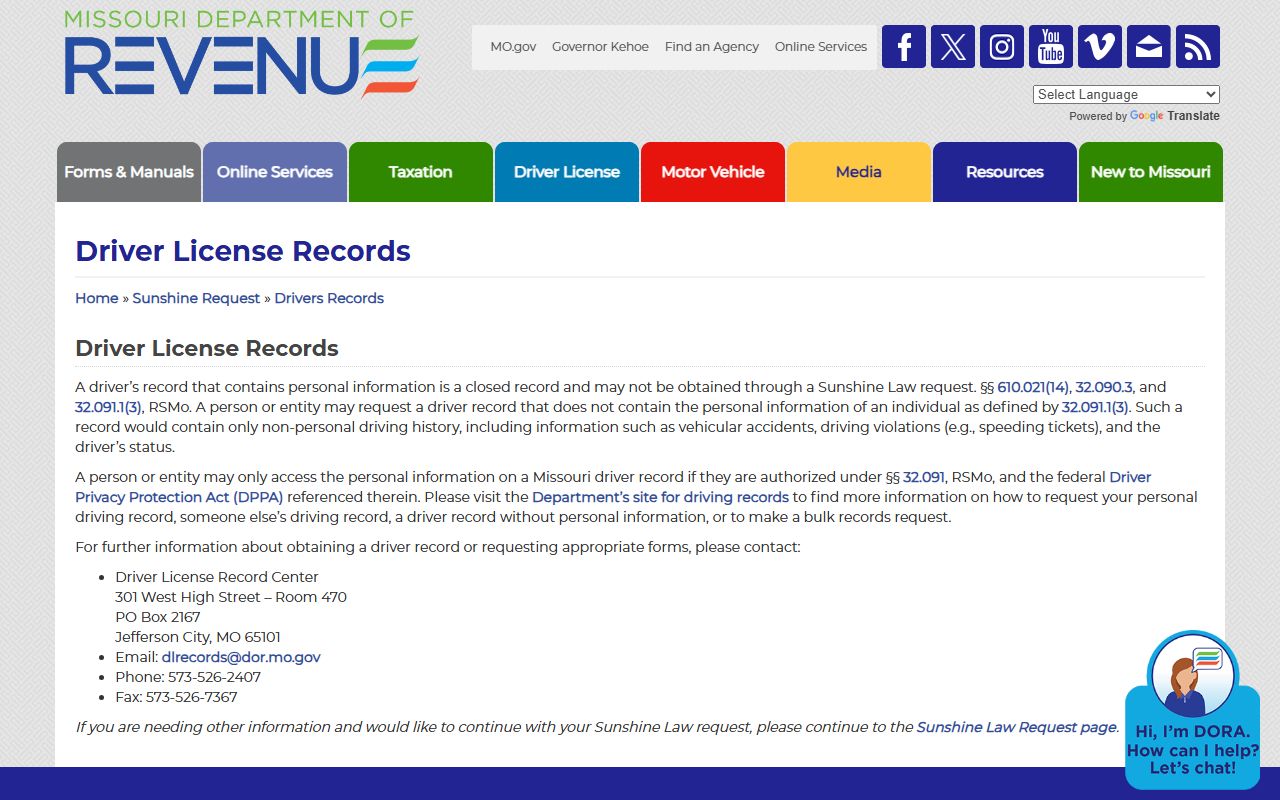
That privacy source is relevant when a charge record intersects with license history or driver-identifying information.
Restricted Lafayette County Charge Records
Missouri's public-access rules do not make every arrest, charge, or investigative detail public. RSMo 610.100 governs arrest and incident reports, including rules for closure when a person is not charged within 30 days and redaction for protected information. RSMo 211.319 limits confidential juvenile files. Sealed and expunged criminal records require statutory authority and court action, and sensitive identifiers such as social security numbers, financial account numbers, minor names, and protected addresses may be withheld.
| Point | Sealed | Expunged |
|---|---|---|
| Public Access | Hidden or limited by statute or court order. | Restricted after statutory relief and court order. |
| Custodian | Circuit Clerk for case records, agency for arrest records. | Both court and law-enforcement custodians may need notice. |
| Effect | Record may still exist for authorized access. | Public access is restricted, but eligibility has exclusions and limits. |
Background checks used for credit, employment, tenant screening, insurance, or similar decisions must follow the Fair Credit Reporting Act and other applicable laws. A casual public record lookup is not a substitute for a legally compliant screening process.
For Lafayette County, the practical access path is split by custodian. Ask the sheriff or arresting agency for law-enforcement arrest or incident material. Ask the Circuit Clerk for the filed court case, docket entries, charge list, disposition, sentence, or certified copies. Ask DOR for driver-record consequences tied to traffic convictions. That split prevents an arrest event, a filed charge, and a conviction from being treated as the same public record.