
Lafayette County Circuit Clerk Contact
Missouri does not use a district clerk structure for Lafayette County trial-court files. The local court-record office is the Circuit Clerk. The county lists Kim Mason as Lafayette County Circuit Clerk, with the public counter at Lafayette Hall. The county also states that all records requests, inquiries, and proposed orders should be emailed to the clerk's court email address. Attachments sent by email are not valid court filings, so pleadings and court documents must still be filed with the Circuit Clerk's Office under applicable law.
Lafayette County Circuit Clerk
Clerk: Kim Mason
Lafayette Hall, 116 S. 10th St.
PO Box 10, Lexington, MO 64067
660-259-6101
Fax: 660-259-6148
Lafayette.email@courts.mo.gov
8:00 AM to 4:30 PM, Monday through Friday
The Circuit Clerk contact page is the source for the clerk's location, phone, fax, email, and filing warning.
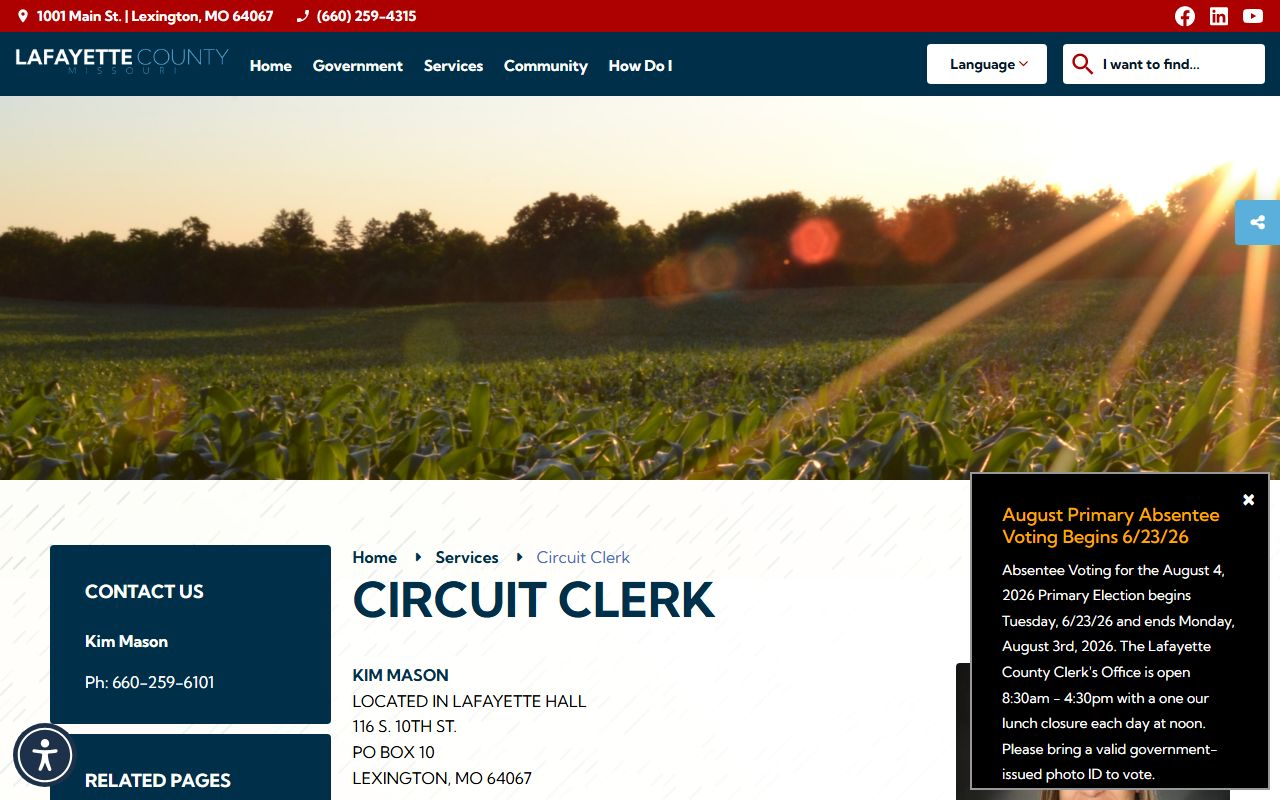
This source is central for Lafayette County Circuit Clerk records because it identifies both the office and the official email channel for court inquiries.
Lafayette County Circuit Clerk Duties
The Circuit Clerk preserves and processes court case records. The office supports courtroom activity, jury management, court financial transactions, public assistance, JIS case management, e-filing by registered users, and transfer of public information to Missouri Case.net. The general court information page says the office employs 10 people. Those duties make the clerk the correct starting point when Case.net does not answer a court-record question or when a user needs a certified copy rather than a screen result.
Lafayette County court records include civil, criminal, traffic, family, probate, small claims, landlord, protection-order, and other case categories. The Circuit Clerk is also tied to payments after disposition, juvenile restitution payments, and jury-service administration through Show-Me Jury. The office cannot provide legal advice. Staff can identify records access channels, payment status, hearing information, forms, and clerk procedure, but legal strategy must come from counsel or self-help resources approved for public use.
The clerk's role is broader than a public counter. The office connects local court events to the statewide case system, collects court-ordered costs after disposition, and supports courtroom scheduling. For users, that means one Lafayette County Circuit Clerk inquiry can touch several different tasks: finding a case number, checking whether a balance may be payable online, asking whether an older file must be pulled, or confirming which courtroom or division has a pending setting.
- Case processing and preservation of Lafayette County court records.
- Public assistance for records requests, copies, and case inquiries.
- JIS and e-filing support for registered users.
- Transfer of public case information to Missouri Case.net.
- Payment processing for fines, fees, court costs, and eligible balances.
- Jury-service administration, including Show-Me Jury communications.
Search Lafayette County Clerk Records
Public court case information starts with Missouri Case.net. Lafayette County says the court office uses the Judicial Information System for case processing and case management, and that JIS enables electronic transfer of public information to Case.net. Searches may use litigant name, case number, filing date, scheduled hearings, judgment index, and Pay By Web options. If Case.net does not show the needed record, the clerk email and public counter become the fallback.
| Search or Request Field | Required | Notes |
|---|---|---|
| Case number | No, but helpful | Use it when known from a summons, ticket, docket entry, or clerk notice. |
| Party names | Yes | Include full names and business names if the case is not known by number. |
| Case type | Helpful | Civil, criminal, traffic, family, probate, municipal, or other known category. |
| Filing date or year | Helpful | Needed for older or non-digitized files. |
| Copy type | Yes for copy orders | Say whether plain, certified, or document-specific copies are needed. |
| Contact information | Yes | Provide phone or email so the clerk can confirm fees and availability. |
The general court information page repeats the Case.net and court-office context for Lafayette County.
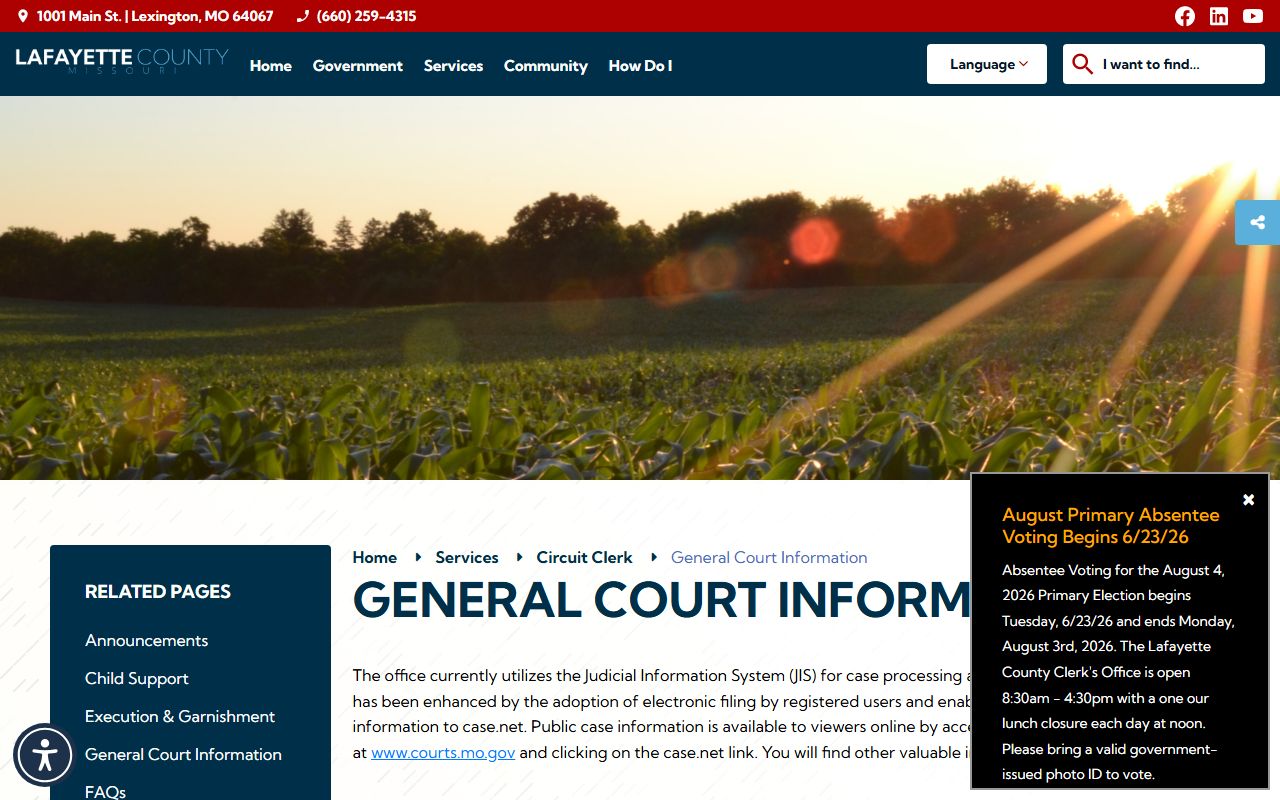
That general information is useful for record access because it links the local clerk's JIS work to the state public case system.
Search results should be read as starting points. A public docket can show party names, charges or claims, hearing dates, orders, disposition, and payment eligibility where remote access permits. It may omit confidential filings, sealed material, juvenile details, or documents that require a clerk copy request. That is why the Lafayette County Circuit Clerk email remains part of the records-access chain even when Case.net returns a public entry.
Request Certified Lafayette County Copies
Certified copies are requested from the Circuit Clerk when a court record must carry official clerk certification. The research file does not include a Lafayette County certified-copy fee schedule, so current costs should be confirmed before ordering. A careful request helps staff find the right file and determine whether remote release is allowed. Older files, confidential records, expunged records, juvenile material, and documents with protected data may need more review than a routine public docket entry.
- Search Case.net first and note the case number, case type, party names, and filing date if available.
- Email Lafayette.email@courts.mo.gov or contact the Lafayette Hall counter with the record details.
- State whether a plain copy, certified copy, docket sheet, order, disposition, or other document is needed.
- Ask the clerk to confirm release, fee, payment method, pickup, mailing, or other delivery steps.
Note: Email is accepted for records requests and inquiries, but emailed attachments are not valid court filings.
Lafayette County Clerk Payments
The Circuit Clerk payment page says most fines, fees, and court costs assessed against parties are ordered paid through the Circuit Clerk and are expected upon disposition. Lafayette County participates in Missouri Courts Pay By Web. Traffic, conservation, and watercraft citations eligible through the Fine Collection Center are eligible for Pay By Web. Traffic fines, civil court cost balances, and criminal court cost balances may also be eligible online when the case qualifies.
| Payment or Fee Topic | Local Detail |
|---|---|
| Accepted counter methods | Cash, money order, cashier's check, debit card, credit card, and Lafayette County resident personal checks. |
| Credit cards | Credit-card payments carry a processing fee. |
| Pay By Web | Eligible traffic, conservation, watercraft, civil, and criminal balances may appear online. |
| Unpaid balances | Debts under payment-plan policy may be sent to Tax Intercept and Debt Collection programs. |
| Certified copies | Fee amount was not captured in the research file; verify with the clerk before ordering. |
Lafayette County Circuit Clerk Forms
The Circuit Clerk forms page states that only pro se forms approved by the Supreme Court or listed locally are acceptable in Lafayette County. Supreme Court-approved categories include Filing Information Sheet, Adult Abuse, Child Protection, Child Support, Civil, Family Access, General, Probate, and Small Claims. Local document-center categories include domestic law forms, opening interrogatories with and without children, marital and nonmarital asset and debt statements, income and expense statements, production requests, financial-record authorization, and property debt grids.
The document center has a search field for file name and a reset button. It is a form source, not a public case-record database. The right workflow is to search or request case records through Case.net and the clerk, then use the form center only when a proper form is needed for filing or case procedure. For divorce-related court records, the form page may show dissolution materials, while the actual case data remains a Circuit Court record.
The image below is sourced from the Lafayette County Circuit Clerk forms and document center.
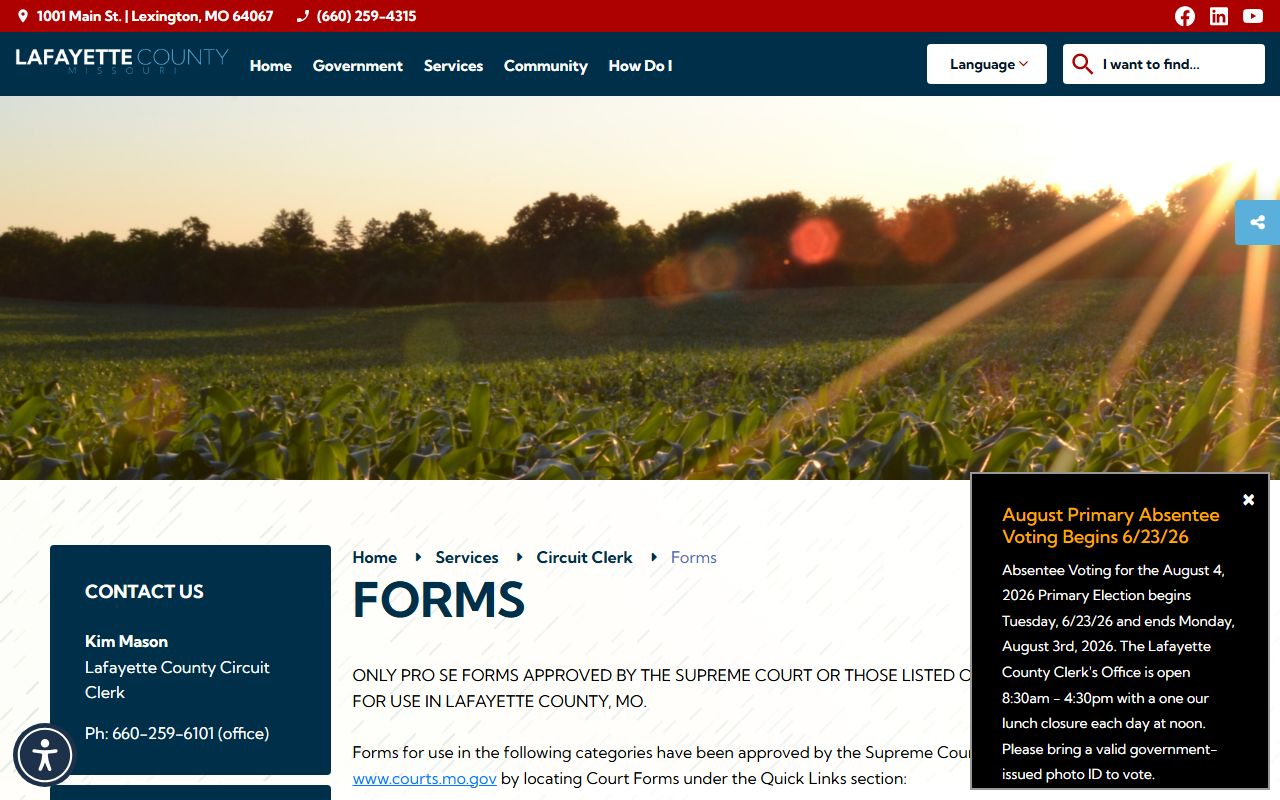
The forms source helps separate court-document preparation from record lookup, which prevents a form search from being mistaken for a case search.
Form limits matter in self-represented cases. The local page says only approved pro se forms or locally listed forms are acceptable, so a document found elsewhere may not be accepted. Probate, small claims, adult abuse, child protection, child support, civil, family access, and general categories are all named in the accepted form list, but filing the right form does not guarantee that every part of the resulting case file will be public.
Circuit Clerk or Recorder
Lafayette County has a split-by-function records structure. The Circuit Clerk handles court records. The Recorder of Deeds is a separate county office for real estate deeds, subdivision plats, surveys, powers of attorney, tax liens, real-estate UCC documents, military discharges, marriage licenses, and miscellaneous recorded instruments. Birth and death records are not handled by the Recorder. They go through the Health Department or Bureau of Vital Records.
| Record Need | Office | Reason |
|---|---|---|
| Civil, criminal, traffic, probate, family, or docket records | Circuit Clerk | These are court case records. |
| Marriage license or recorded marriage information | Recorder of Deeds | Marriage records are recorded-document records, not court case files. |
| Land records, plats, surveys, tax liens, or real-estate UCCs | Recorder of Deeds | These are recording-office documents. |
| Divorce case records | Circuit Clerk | Dissolution cases are Circuit Court records. |